Download
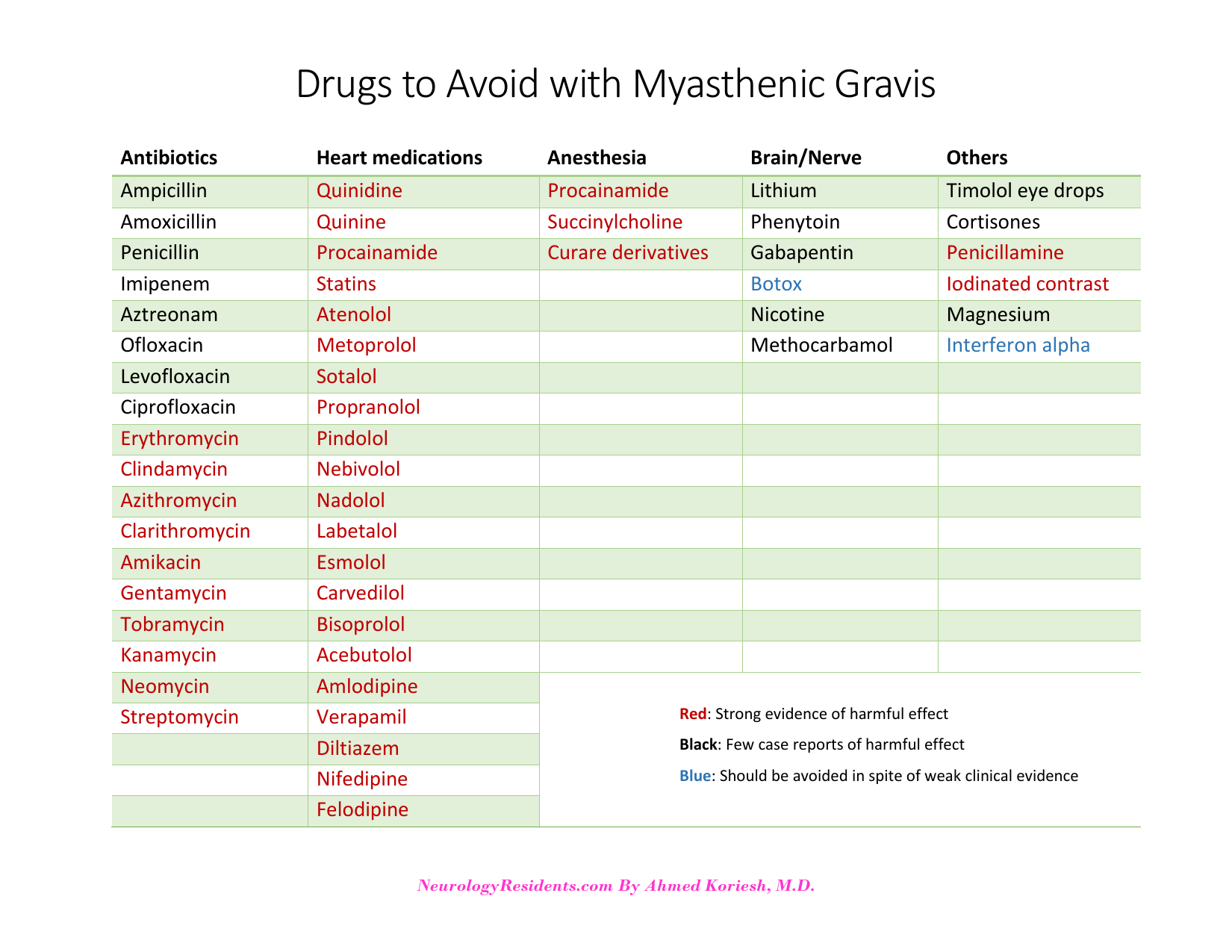
Myasthenia Medication Handout
Printable patient-friendly list of medications to avoid.
NeuroResidents
Printable patient-friendly list of medications to avoid.
Assessment:
1. Myathenic Crisis:
Plan
Neurological:
- Neuro checks q4h
- Low threshold for intubation if increased work of breathing (MG patients can maintain good sats), Will follow PFT (FVC/NIF/MEF) q6h.
- Avoid medications that worsens myasthenia
- Meds:
Will start on IVIG 0.4gm/kg daily for 5 days
Continue pyridostigmine at dose ***
Continue home prednisone dose ***
___________________
Respiratory:
- FVC/NIF/MEF Q4h
- Aspiration precautions, head of bed above 30 degrees
- PRN O2
- Baseline CXR
- Suctioning q1-2 hours
- Meds:
None
_______________________________________________
Cardiology:
- Continuous cardiac telemetry
- Meds:
None
________________________________________________
Renal:
- Renal function normal
- Monitor daily BMP, Mg, Phos while on IVIG
- Meds:
IVFs NS @ 75/hr
_______________________________________________
Gastrointestinal:
- NPO for now till speech evaluation
- Meds:
________________________________________________
Endocrinology:
- FSBS q6hr
- Meds:
- Insulin SS
________________________________________________
Hematology:
- Monitor CBC daily
- SCDs for prophylaxis; enoxaparin 40mg SC daily
- Meds:
enoxaparin 40mg SC daily
________________________________________________
Infectious Disease:
- Current access: PIVs
- Meds:
none
_______________________________________________
Prophylaxis:
DVT: SCDs, enoxaparin 40mg SC daily
____________________________________________________________________________________________
Discharge Planning:
Patient requires *** (ICU or Step down) level of care for monitoring of respiratory functions.
Antibiotics: Quinolones - Monobactams - Lactams - Macrolides - Aminoglycozides
Antiarrythmics: Quinine - Quinidine - Procainamide
BP medications: Beta blockers (including timolol eye drops) - Calcium channel blockers
CNS medications: Antiepileptic drugs - Lithium
Local anasthetics: Procainamide
Neuromuscular blocking agents: Succinylcholine - Curare medications
Others: Penicillamine - Steroids (needs supervision) - Iodinated contrast agents - Magnesium containing medications
..
- The 20/30/40 role: alarming values if FVC < 20ml/kg or NIF < 30cmH2O or MEP < 40cmH2O. These measures help to guide the level of admission (ICU/step down/floor), not to guide the decision for intubation. If FVC < 20ml/kg --> ICU admission is preferred.
- FVC is the most sensitive measure, NIF/MEP are effort dependent and less reproducible compared to FVC. Moreover NIF/MEP are unreliable if the face mask is leaking.
- Don't depend on the numbers only for intubation. Patient should be either in respiratory distress while resting in bed without activity or hypercapnic to consider intubation.
- No respiratory distress --> no need for respiratory support --> admit to step down
- Mild/Moderate respiratroy distress --> consider BIPAP or Hiflow nasal cannula if BIPAP is contraindicated (secretions - nausea - vomiting). It must be done in ICU for lose monitoring of respiratory distress, if didn't improve (RR decrease, less use of accessory muscles) --> intubate.
- Severe respiratory distress --> intubation and mechanical ventillation.
ICU template for secured airway SAH patients with vasospasm surveillance and critical care planning.
Open SectionICU template for awake SAH patients with Nimodipine, blood-pressure goals, and TCD workflow.
Open Section
Critical-care template for intubated intracerebral hemorrhage patients.
Open SectionICU template for non-intubated ICH patients requiring close neurocritical care monitoring.
Open Section
Burst-suppression ICU template plus a downloadable step-by-step protocol sheet.
Open Section
Neuro-ICU note template for reperfused ischemic stroke patients after intervention.
Open Section