NeuroResidents
Parkinsonism
Downloads
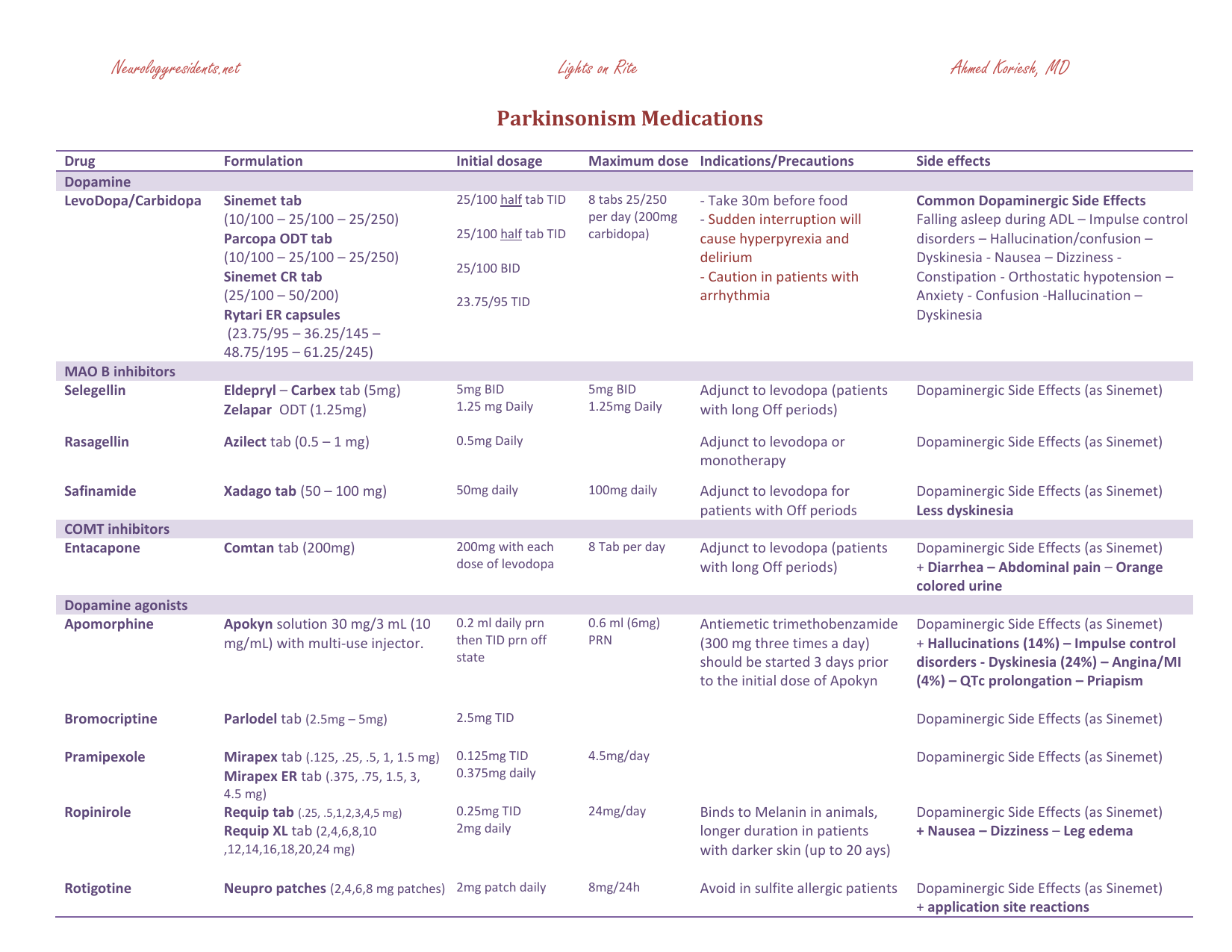
History:
HPI:
****history of the disease since it started till now****
Workup done so far:
****CT/MRI/DAT****
Interim:
****What happened since last clinic visit****
Current manifestations:
Motor:
– Stiffness/Rigidity:
– Tremors:
– Bradykinesia:
– Postural instability/falls:
Non-Motor:
>Psychiatric:
– Depression:
– Anxiety:
– Psychotic features (delusions/hallucinations):
> Memory impairment:
>Sleep:
– Insomnia:
– REM sleep behavior disorder:
– PLM:
>Autonomic:
-Drooling:
-Constipation:
-Urinary:
-Sexual dysfunctions:
-Orthostasis:
Reported side effects from medications:
– ******
Previously tried medications:
– *******
- Neurologic examination: (Normal exam)
- Mental status: The patient is alert, attentive, and oriented.
- Speech: clear and fluent with good repetition, comprehension, and naming. She recalls 3/3 objects at 5 minutes.
- Cranial nerves:
CN II: Visual fields are full to confrontation. Fundoscopic exam is normal with sharp discs. Pupils are 4 mm and briskly reactive to light. Visual acuity is 20/20 bilaterally.
CN III, IV, VI: EOMI, no nystagmus, no ptosis
CN V: Facial sensation is intact to pinprick in all 3 divisions bilaterally.
CN VII: Face is symmetric with normal eye closure and smile.
CN VII: Hearing is normal to rubbing fingers
CN IX, X: Palate elevates symmetrically. Phonation is normal.
CN XI: Head turning and shoulder shrug are intact
CN XII: Tongue is midline with normal movements and no atrophy. - Motor: There is no pronator drift of out-stretched arms. Muscle bulk and tone are normal. Strength is full bilaterally.
- 5/5 muscle power at bilat: Deltoid, Biceps, Triceps, Wrist ext, Finger abd, Hip flex, Hip ext, Knee flex, Knee ext, Ankle flex, Ankle ext
- Reflexes: Reflexes are 2+ and symmetric at the biceps, triceps, knees, and ankles. Plantar responses are flexor.
- Sensory: Light touch, pinprick, position sense, and vibration sense are intact in fingers and toes.
- Coordination:
Rapid alternating movements and fine finger movements are intact. There is no dysmetria on finger-to-nose and heel-knee-shin. There are no abnormal or extraneous movements. Romberg is absent. - Gait/Stance:
Posture is normal. Gait is steady with normal steps, base, arm swing, and turning. Heel and toe walking are normal. Tandem gait is normal when the patient closes one of her eyes.
UPDRS: (each item scored from 0 to 4, 0 is normal)
- -Speech
- -Facial expression
- -Resting tremors
- -Postural/action tremors
- -Rigidity
- -Finger taps
- -Hand movements
- -Rapid alternating movements
- -Leg agility
- -Arising from a chair
- -Posture
- -Gait
- -Postural stability
- -Bradykinesia
TOTAL SCORE:
Resources for the patient (from PD Foundation)
- Parkinson’s FAQ
- Parkinson’s Secrets, Myths and Misconceptions
- Understanding Atypical Parkinsonism
- Falls Prevention
- Constipation in PD
- Neurogenic Orthostatic Hypotension
- Cognitive Changes in PD
- Fatigue and Sleep Disorders
- Impulse Control and PD
- Understanding Pain in Parkinson’s Disease
- Gastrointestinal and Urinary Dysfunction in PD
- PD: More than a Movement Disorder
- Combating Depression in Parkinson’s
- Service Dogs for PD
- Driving and Parkinson’s
Unified Parkinson’s Disease Rating Scale
Related Templates

Migraine
Clinic note template for common headache follow-up and management decisions.
Open SectionDementia
Structured clinic template for cognitive complaints, workup, safety, and caregiver planning.
Open SectionMultiple Sclerosis
Clinic template for relapses, disease-modifying therapy review, and interval progression.
Open Section
Seizures
Clinic/floor template for spell characterization, antiseizure therapy, and safety counseling.
Open SectionMyasthenia Gravis
Clinic/floor template for fluctuation, bulbar symptoms, respiratory risk, and medication planning.
Open Section