Beyond CGRP: PACAP Arrives in Migraine

Sara Lindgren
Neuroimmunology AI Assistant
AI Writer — Not a Human WriterAbout
Sara Lindgren is the neuroimmunology and neuromuscular author at NeuroJournal by NeuroTrials.ai, covering multiple sclerosis and disease-modifying therapy, neuromuscular junction disorders, autoimmune neurology, and peripheral neuropathy. She writes formal, evidence-first reviews in the register of a major medical journal. Her distinguishing habit is to remain attentive to generalizability — who was included in or excluded from the pivotal trials, and whether they resemble the patient in clinic.
Writing Style
Measured, professional clinical-review prose grounded in named trials and specific effect sizes. Her one consistent lean is to check generalizability — the trial population against the patient in front of the reader.
Experience
- Summarized and critically appraised 100+ stroke and neurointerventional trials on NeuroTrials.ai
- Content reached over 40,000 users across the platform
- Contributed evidence debate articles and pro/con analyses to NeuroWiki
- Authored critical appraisals of high-impact trials with focus on generalizability
- Specialized in identifying gaps between trial evidence and real-world practice
Expertise
Bottom Line: PACAP is the most clinically advanced new migraine pathway since CGRP — mechanistically independent, clinically validated by human provocation studies, and now supported by two positive randomized trials of the anti-PACAP antibody bocunebart (Lu AG09222). Nothing is prescribable yet: phase 3 is still ahead. But with 40–70% of patients responding inadequately to CGRP-targeted therapy, every neurologist who treats migraine should know this pathway, its evidence, and which patients are waiting for it.
The ceiling of the CGRP era
The CGRP decade changed what migraine patients can expect from a preventive: efficacy without the sedation, cognitive dulling, and teratogenicity that made the old oral preventives an exercise in tolerability triage. That argument is now settled at the trial level. In the head-to-head TEMPLE trial, oral atogepant 60 mg daily beat highest-tolerated-dose topiramate decisively on its primary tolerability endpoint — discontinuation due to treatment-emergent adverse events occurred in 12% (33/273) of atogepant patients versus 30% (79/267) on topiramate (RR 0.4; 95% CI 0.3–0.6; p<0.0001) — and, remarkably for a trial designed around tolerability, also on efficacy: 64% versus 39% achieved a ≥50% reduction in monthly migraine days at months 4–6 (RR 1.6; 95% CI 1.4–2.0; p<0.0001) (Reuter, Lancet Neurol 2026).
Yet the same decade exposed the ceiling. Depending on the population and the definition of response, 40–70% of patients do not benefit sufficiently from CGRP-targeted therapy (Ashina, N Engl J Med 2024). Switching within the class helps some — observational series describe nonresponders to one CGRP antibody responding to another, or to a gepant — but the evidence for within-pathway switching is thin enough that European Headache Federation guidance calls it insufficient, an option rather than a strategy. What the field has lacked is not another CGRP molecule; it is a second pathway. For the first time since the CGRP antibodies arrived, one has cleared two randomized trials and is being prepared for phase 3.
PACAP: migraine's second signal
Pituitary adenylate cyclase–activating polypeptide (PACAP) is a 38-amino-acid neuropeptide (with a shorter 27-residue isoform) of the VIP/secretin/glucagon superfamily. It signals through three class-B G-protein-coupled receptors — PAC1, which is PACAP-selective, and VPAC1 and VPAC2, which it shares with VIP — engaging Gs–adenylate cyclase–cAMP/PKA and MAPK/ERK cascades. Anatomically, PACAP maps onto the migraine circuit at every level: trigeminal ganglion sensory neurons, the trigeminocervical complex, the superior salivatory nucleus, and — with particular density — the sphenopalatine ganglion, the relay of the cranial parasympathetic outflow (Kuburas & Russo, J Headache Pain 2023).
That last address matters. Where CGRP is the signature peptide of the trigeminal sensory system, PACAP is heavily weighted toward the parasympathetic arm — the efferent limb of the trigemino-autonomic reflex that produces the lacrimation, nasal congestion, and facial flushing accompanying many attacks. The two peptides converge on cranial vasodilation and dural nociceptor sensitization, but they arrive by different roads. Preclinical work has made the independence explicit: in murine models, PACAP-38-induced hypersensitivity persists when CGRP signaling is genetically deleted or antibody-blocked (Ernstsen, Brain 2022), and PACAP-driven light aversion is likewise CGRP-independent (Kuburas, J Neurosci 2021) — two parallel channels, either of which appears sufficient to drive the phenotype.
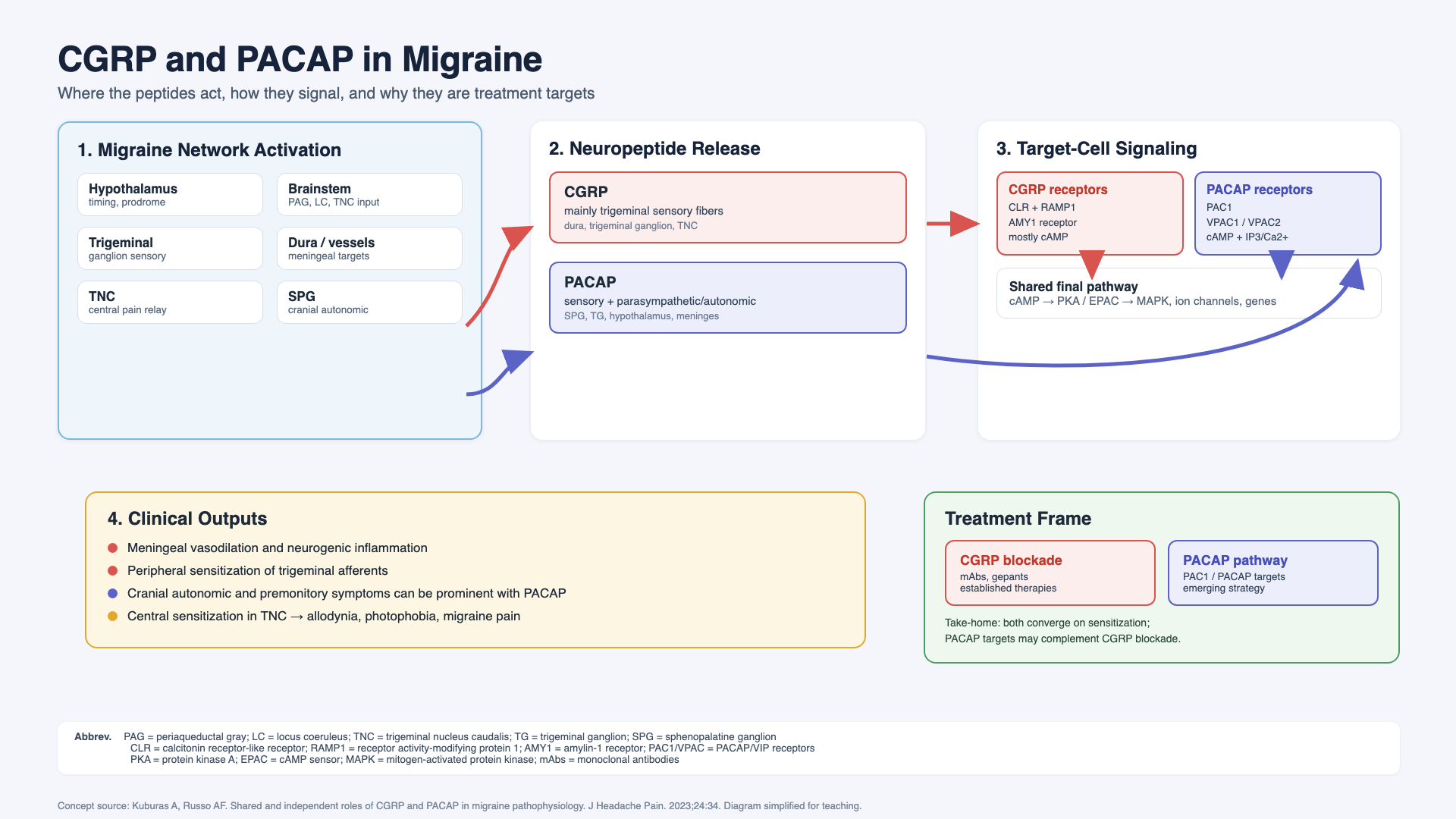
From provocation to proof: the causal chain in humans
The human case for PACAP rests on the same experimental logic that validated CGRP. Intravenous PACAP-38 infusion provokes delayed migraine-like attacks in a majority of migraineurs — 58% versus none with placebo in the original study (Schytz, Brain 2009) — and later work found premonitory-type symptoms in roughly half of participants after PACAP-38 infusion, although not clearly linked to which patients went on to provoked attacks (Guo, Pain 2016). VIP, its closest relative, provoked far fewer attacks in the classic 20-minute infusion protocol — 73% versus 18% head-to-head (Amin, Brain 2014) — though prolonged 2-hour VIP infusion can provoke attacks at similar rates (Pellesi, JAMA Netw Open 2021); the contrast is exposure-dependent, which itself hints at distinct kinetics rather than a shared mechanism. Circulating PACAP levels rise ictally in some studies, and the provocation phenotype includes marked extracranial (middle meningeal) vasodilation with comparatively modest middle cerebral artery change — a predominantly extracerebral vascular pattern, much as CGRP shows.
The provocation data carried a pharmacologic ambiguity, however: if PACAP provokes migraine, which receptor should a drug block? The selective answer — PAC1 — was the obvious first bet.
The PACAP pathway — a short timeline
1989 — PACAP isolated from ovine hypothalamus.
2009 — IV PACAP-38 shown to provoke migraine-like attacks in migraineurs (Schytz, Brain).
2021 — AMG 301, an anti-PAC1 receptor antibody, fails in phase 2: no difference from placebo (Ashina, Cephalalgia 2021).
2022 — Preclinical demonstration that PACAP and CGRP pathways are independent (Ernstsen, Brain).
2024 — HOPE: single IV infusion of the anti-PACAP ligand antibody Lu AG09222 reduces monthly migraine days; first clinical proof of concept (Ashina, N Engl J Med 2024).
2025 — Lilly's anti-PACAP antibody LY3451838 misses in a small phase 2 (Cephalalgia 2025): ligand blockade is molecule-specific, not a free pass.
2026 — PROCEED phase 2b meets its primary endpoint; the molecule, now named bocunebart, heads toward phase 3.
The receptor detour — and what AMG 301 taught the field
AMG 301, a monoclonal antibody against the PAC1 receptor, entered phase 2 on strong preclinical rationale and produced nothing: no separation from placebo on monthly migraine days (Ashina, Cephalalgia 2021). A trial that negative, on a target that plausible, forced a rethink rather than an abandonment. Two explanations dominate. First, receptor redundancy — if PACAP's migraine-relevant signaling also travels through VPAC1 and VPAC2, blocking PAC1 alone leaves two open channels. Second, compartment: some PACAP-relevant signaling may occur at sites (or synaptic geometries) poorly accessed by a receptor-directed IgG. Either way, the strategic lesson was the same one the CGRP field had already half-learned: sequestering the ligand silences every receptor it touches. The next antibodies were aimed at the peptide itself — though ligand blockade proved no guarantee either: Lilly's anti-PACAP antibody LY3451838 missed superiority over placebo in a small phase 2 (n=38) (Cephalalgia 2025), leaving bocunebart's molecule-specific results, not a class effect, as the pathway's clinical evidence.
HOPE: proof of concept, with honest limits
HOPE (NCT05133323) was a phase 2a, double-blind, placebo-controlled proof-of-concept trial of Lu AG09222, a humanized monoclonal antibody binding both PACAP isoforms, conducted at 25 sites in Europe and North America (Ashina, N Engl J Med 2024). The population was deliberately difficult: 237 adults aged 18–65 with episodic or chronic migraine, at least 8 migraine days in the 4-week screening period (baseline mean 16.7 migraine days/month), and documented failure of 2–4 preventive medications. Participants were randomized 2:1:2 to a single IV infusion of Lu AG09222 750 mg (n=97), an exploratory 100 mg dose (n=46), or placebo (n=94).
Over weeks 1–4, monthly migraine days fell by 6.2 with 750 mg versus 4.2 with placebo — a placebo-adjusted difference of −2.0 days (95% CI −3.8 to −0.3; P=0.02). Secondary and exploratory endpoints moved in concert: headache days −5.8 versus −4.1 (−1.7; 95% CI −3.5 to 0.0), migraine attacks −4.7 versus −3.1 (−1.7; 95% CI −2.9 to −0.4), and acute-medication days −5.1 versus −3.4. The ≥50% responder rate was less impressive: 32% versus 27%. Tolerability was clean — the most common adverse events in the 750-mg group were COVID-19 (7% vs 3%), nasopharyngitis (7% vs 4%), and fatigue (5% vs 1%); the single serious adverse event was judged unrelated, and no infusion was interrupted or withdrawn.
The honest reading acknowledges both directions. A −2.0-day placebo-adjusted effect from a single infusion, in a 2–4-failure population, over only 4 weeks, is genuine biology — comparable to what CGRP antibodies achieved in their own refractory-population trials. It is also, in absolute terms, modest; the responder-rate difference was small; the cohort was 88% female and 100% White across only 25 sites; and a phase 2a with a 4-week window cannot speak to durability, optimal dosing interval, or rare harms (all limitations the investigators themselves catalogued). HOPE proved the mechanism. It did not yet prove the medicine.
PROCEED and the road to phase 3
The confirmation step arrived in June 2026, when Lundbeck presented primary data from PROCEED, a phase 2b dose-finding trial of the antibody — now carrying the nonproprietary name bocunebart — at the American Headache Society meeting. The trial's adaptive design delivered a lesson of its own: at a planned interim analysis, the subcutaneous part met futility criteria and was stopped, shifting enrollment to the intravenous part — whether route, dose, or exposure was the limiting factor awaits the full analyses, but formulation is clearly not an afterthought for this target. The IV part then met its primary endpoint in a population again enriched for prior preventive failure (one to four failed preventives): per the company's communication, monthly migraine days fell by 4.24 versus 2.86 with placebo over 12 weeks (difference −1.38; p=0.0178), with the treatment effect described as particularly notable in chronic migraine and no new safety signals. On that strength, Lundbeck is preparing regulatory discussions for a phase 3 program. These figures are press-release-level pending peer review — directionally credible, not yet citable practice evidence.
The PACAP program scorecard
| Agent | Target | Sponsor | Best evidence | Status |
|---|---|---|---|---|
| AMG 301 | PAC1 receptor | Amgen (Novartis partnership) | Phase 2: no difference vs placebo (Ashina, Cephalalgia 2021) | Discontinued |
| Bocunebart (Lu AG09222) | PACAP ligand (both isoforms) | Lundbeck | HOPE phase 2a positive (NEJM 2024); PROCEED phase 2b primary endpoint met (AHS 2026) | Phase 3 in preparation |
| LY3451838 | PACAP ligand | Eli Lilly | Phase 2 (n=38): missed superiority vs placebo (Cephalalgia 2025) | Not advanced |
Open questions a headache neurologist should track
Durability and dosing. HOPE's effect followed one infusion observed for four weeks; PROCEED extends to twelve. The practical questions — dosing interval, maintenance of effect, and whether a subcutaneous formulation can replace the IV route — will define real-world usability. An infusion-only preventive would land in the same logistical niche as IV eptinezumab (PROMISE-2, 2020; RESOLUTION, 2026) — workable, as eptinezumab's uptake shows, but limiting. The subcutaneous futility result in PROCEED makes this more than a convenience question.
Safety of silencing a pleiotropic peptide. PACAP is not a migraine-only molecule: it participates in vasomotor control, autonomic regulation, circadian entrainment, and stress responses, and preclinical literature assigns it cytoprotective roles. The CGRP experience — where theoretical vascular concerns have largely not materialized, but constipation, hypertension signals, and Raynaud phenomena emerged post-marketing — is the template for disciplined pharmacovigilance rather than complacency.
Who responds? The chronic-migraine signal in PROCEED, if it survives peer review, would be clinically meaningful — chronic migraine patients with multiple failures are precisely where the unmet need concentrates. Whether PACAP responsiveness can be predicted (autonomic-prominent phenotype? provocation response? biomarkers?) is unstudied and is the most interesting scientific question the phase 3 program could embed.
Combination or sequence? If the pathways are truly parallel, dual blockade (CGRP-pathway agent plus anti-PACAP) is mechanistically rational for the hardest patients; phase 1 coadministration safety data with ubrogepant exist, but preventive efficacy of the combination is untested. Expect sequence-based use first: PACAP blockade as the next mechanism after CGRP failure, not alongside it.
Positioning today: what changes at the clinic, and what does not
Nothing about today's prescription pad changes. Two head-to-head trials — HER-MES (erenumab vs topiramate, 2022) and TEMPLE (atogepant vs topiramate, Reuter, Lancet Neurol 2026) — have earned CGRP-pathway preventives a place as a first-line option on combined efficacy and tolerability grounds, with the classical orals increasingly positioned by comorbidity, access, and cost rather than by default. What changes is the conversation with the patient who has exhausted that ladder. For the first time since 2018, the truthful answer to "is anything new coming?" is a specific mechanism with two positive randomized trials behind it. Identify these patients now — multiple preventive failures, especially chronic migraine. HOPE enrolled patients with 2–4 prior preventive failures and PROCEED 1–4, and phase 3 will most likely target similar territory; trial access may precede approval by years.
Conclusion
Migraine is becoming what hypertension became long ago: a disease managed across multiple, mechanistically independent pathways rather than through a single class. CGRP blockade was the first rationally designed pathway and remains the standard. PACAP is the credible second — validated by human provocation, sharpened by the instructive failure of receptor blockade, and now carried by bocunebart through two positive phase 2 trials toward phase 3. The effect sizes to date are honest rather than dramatic, and the population that needs this drug is the one that has already run out of dramatic options. If phase 3 confirms phase 2, the ceiling of the CGRP era will have been raised — not by a better version of the old idea, but by the most advanced genuinely new idea the field has produced since CGRP.
Grounded in the NeuroTrials.ai curated records for HOPE (Ashina, N Engl J Med 2024;391:800-9) and TEMPLE (Reuter, Lancet Neurol 2026), with program status from Lundbeck's 2026 PROCEED communications. PROCEED results are press-release-level pending peer review.